For forty years computing got more personal. Mainframe, mini, desktop,
laptop, phone.
Then intelligence arrived — and went straight back into somebody
else's building.
You rent it by the token. It reads everything you give it. That is
time-sharing with a subscription button.
Own 1 puts it back where it
belongs. Intelligence should run where its owner decides, cost what the market says it costs,
and remember only what its owner allows.
0Local LLMs at once
0Concurrent agents
0TOPS on device
0Private encrypted vault
0People per machine
0Per-token cost
Built-in LLMs
Local and cloud models available across the entire system as shared intelligence
services.
x402 Payments
Agents can pay for approved models, APIs and compute under system-level spending
policy.
Ultra secure
TPM2-protected keys, containerised execution, Btrfs snapshots and one-command
rollback.
The category
Personal AI computers are a new category — and it is
growing fast.
Apple, NVIDIA and a handful of others are now building for the same desk.
That is a good sign: it means the argument for running intelligence locally has been won. The
question is no longer whether a machine can hold a large open model. It is what the operating
system does once the model is loaded.
Own 1
Own 1
An AI-native computer. The intelligence is resident, and the OS is built
around it.
Local models at once2
Agents, OS-managed8 + SuperAgent
On-device AI99 TOPS
Concurrent seatsUp to 10
StorageUp to 8 TB, replaceable
From$3,899
versus
Comparison
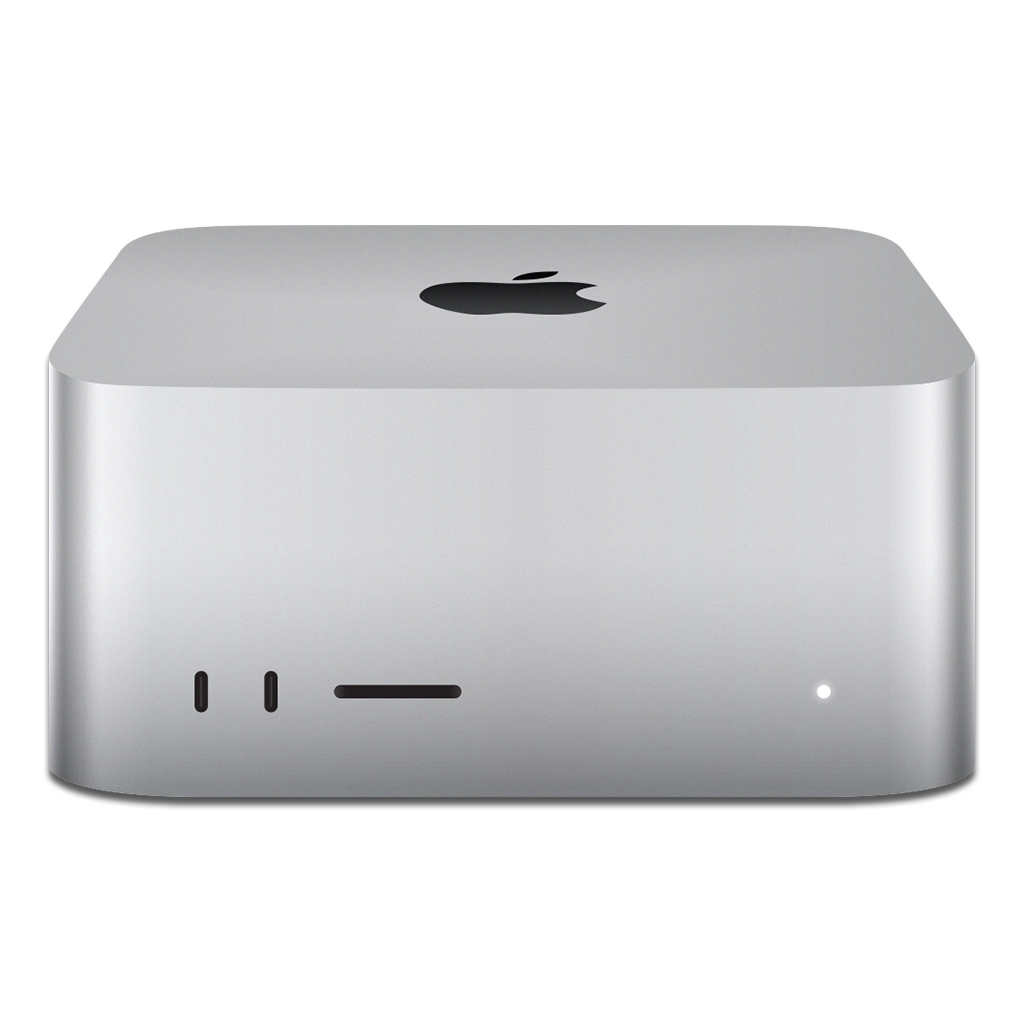
Mac Studio
Superb hardware. With enough unified memory it will hold a large open
model — as a program you run, not a system you own.
Local models at onceManual
Agents, OS-managedNone
On-device AINeural Engine
Concurrent seatsSingle-seat
StorageSoldered
Configured to matchMaterially higher
Illustration, not a product photograph. Verify current Apple configurator
pricing before publishing any figure.
What changes once the model is loaded.
Capability
Own 1
Mac Studio
Runs open models locally
Yes
Yes
Local model runtime built into the OS
Yes
Install it yourself
Two local LLMs at once, plus 8 agents
Yes
Manual orchestration
Agent identity as an OS primitive
Yes
None
Per-agent budgets and spending limits
Yes
None
Native wallet and machine payments
Yes
None
Atomic rollback to a previous system
Yes
Time Machine restore
Bursts to a priced compute market
Yes · 34 providers
None
App store for models, agents, skills, MCPs
Yes
General apps
Shared by 5–10 concurrent users
Yes
Single-seat
Open source, forkable, inspectable
Yes
Proprietary
User-replaceable storage
Yes
Soldered
Comparison at broadly matched memory and storage. Apple leads on display
pipeline, creative tooling and ecosystem maturity — if those are your constraints, buy the Mac.
Proof
1,224 runs. 44 models. One apartment in Manila.
No datacenter, no cloud, no outbound API calls — one fanless Own 1 with
integrated graphics, 7 May to 30 June 2026.
1,224Runs over 55 days
44Models tested
162/164Video runs on iGPU
104Failures kept in the data
Thirty-one days of optimisation on
identical hardware — every gain came from software. The 104 failures stay in the published
dataset because they mark exactly where a small machine stops and OwnXCloud starts.
What it is
A personal computer built around local intelligence.
Own 1 runs open language, vision and voice models on your desk — with
on-device privacy, AI-native security, native agents, a machine wallet and a direct path to
OwnXCloud when a workload genuinely needs more.
01
Local-first
Models, agents and data stay on device by default. Not as a setting — as the design.
02
AI-optimized
Silent thermals tuned for continuous inference. Agents that run all night, not until it throttles.
03
Hybrid
OwnXCloud on tap when a workload needs global compute, under rules you set.
04
Ownable
Rollback recovery, open software, no forced services, nothing soldered shut.
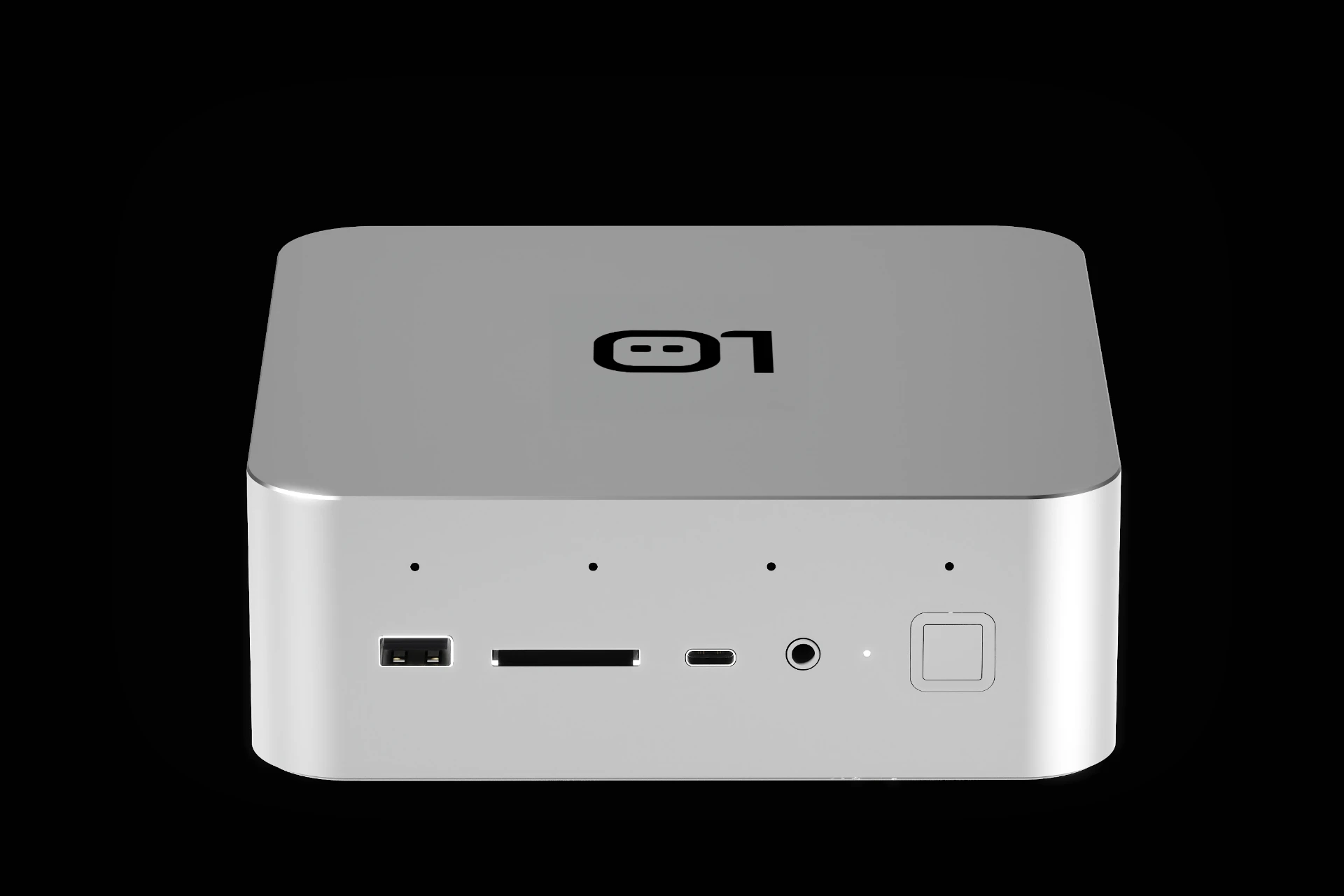
The object
Machined, not moulded.
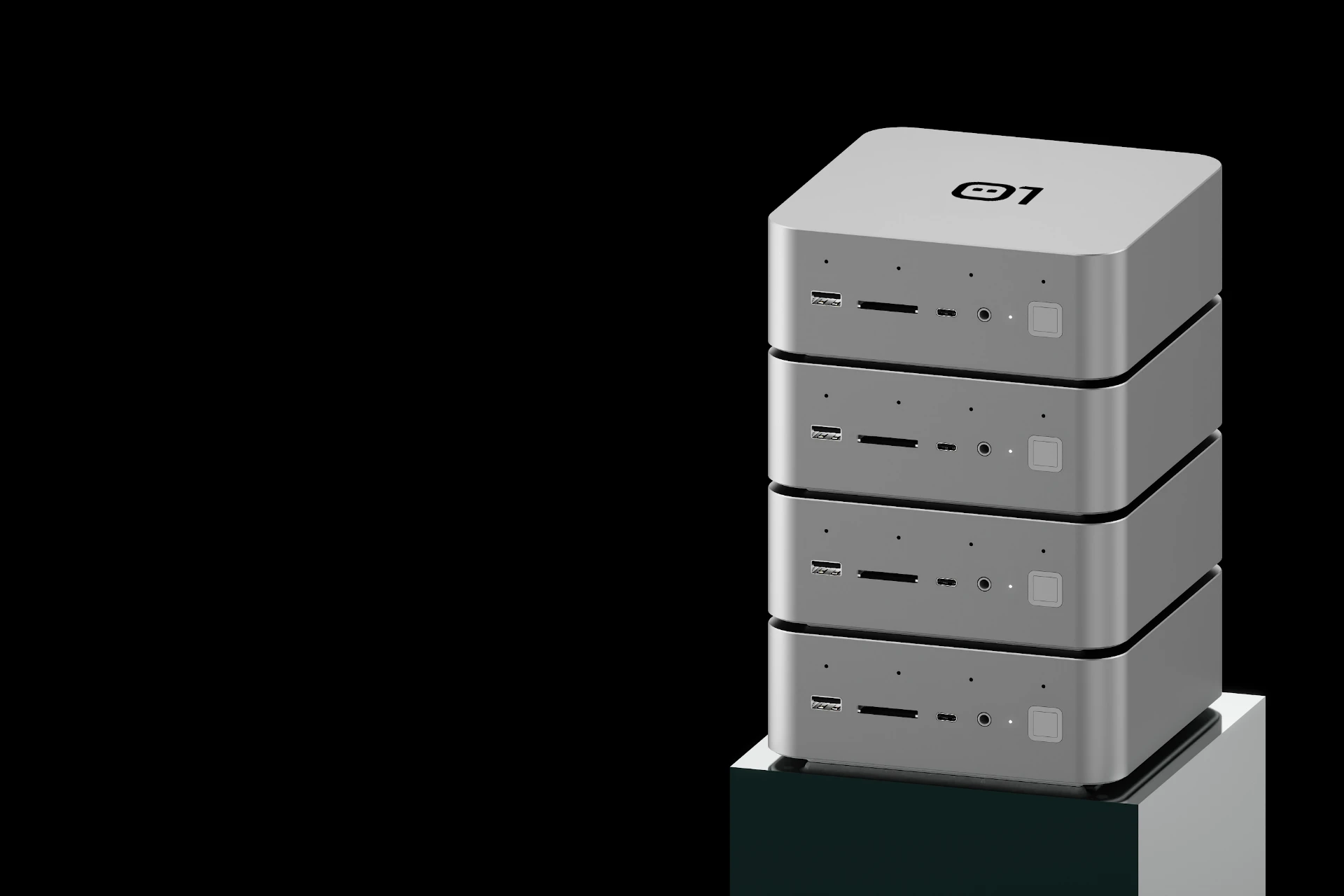
A fanless aluminium body sized for a desk, not a rack. Silent enough to sit
beside while eight agents work through the night.
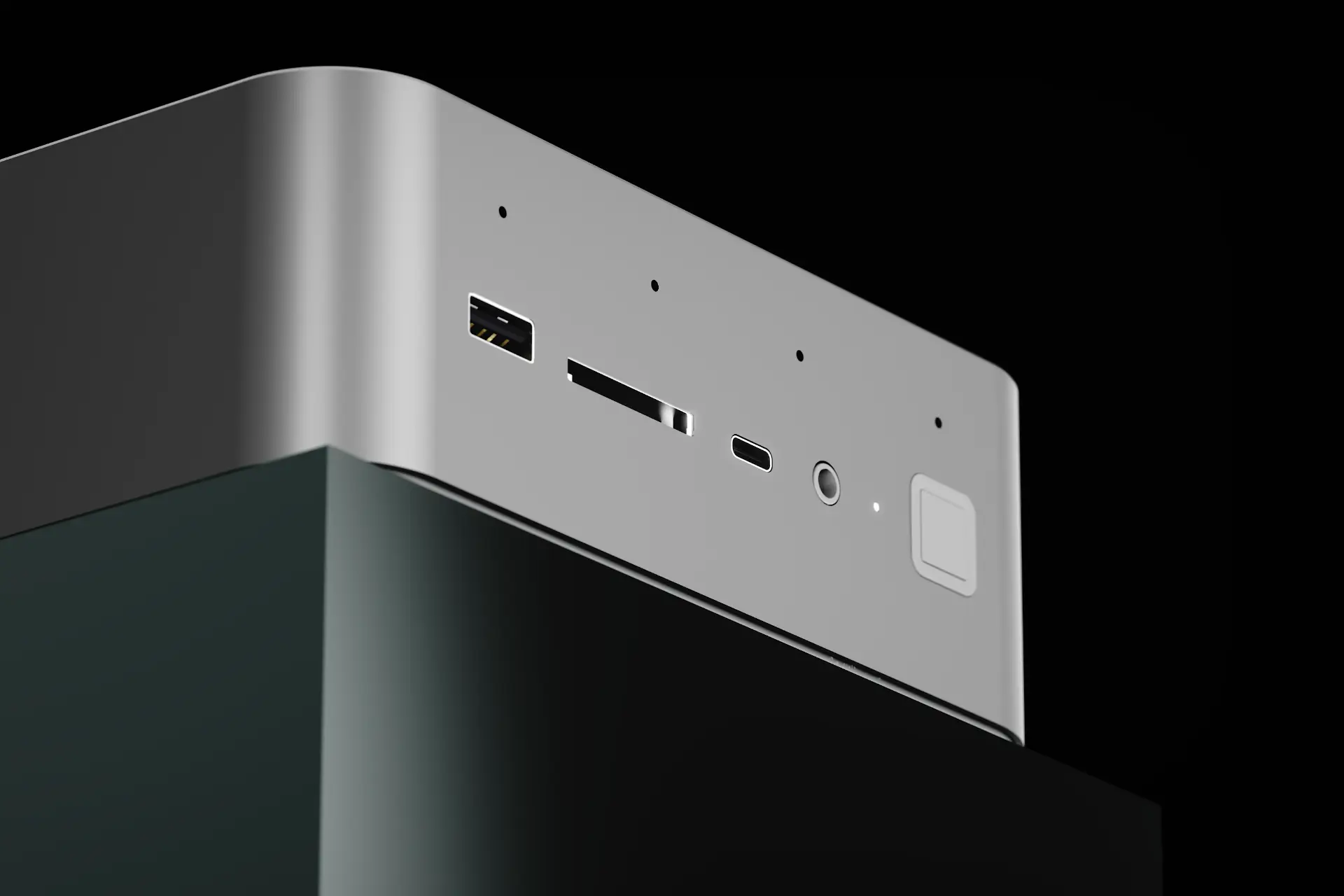
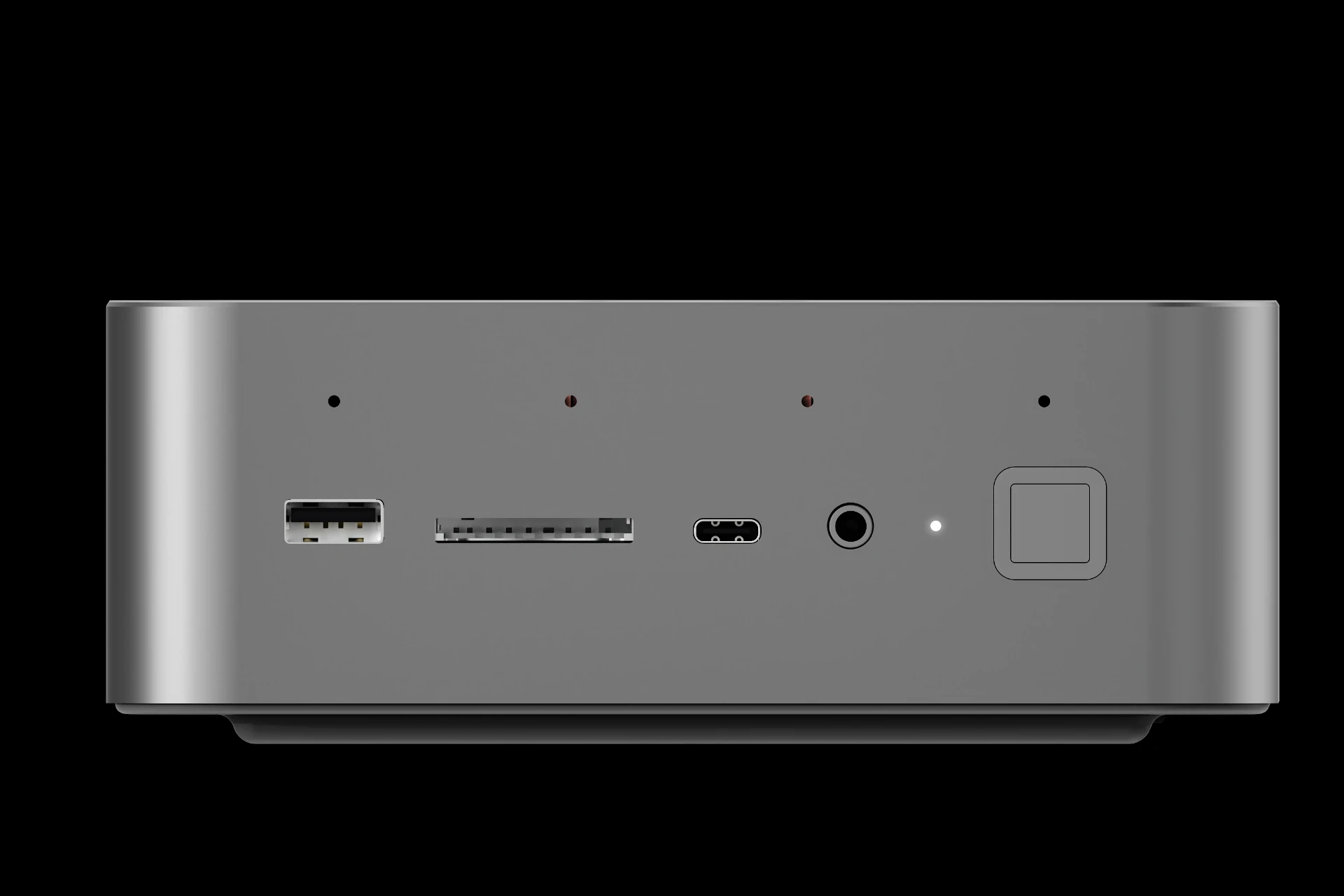
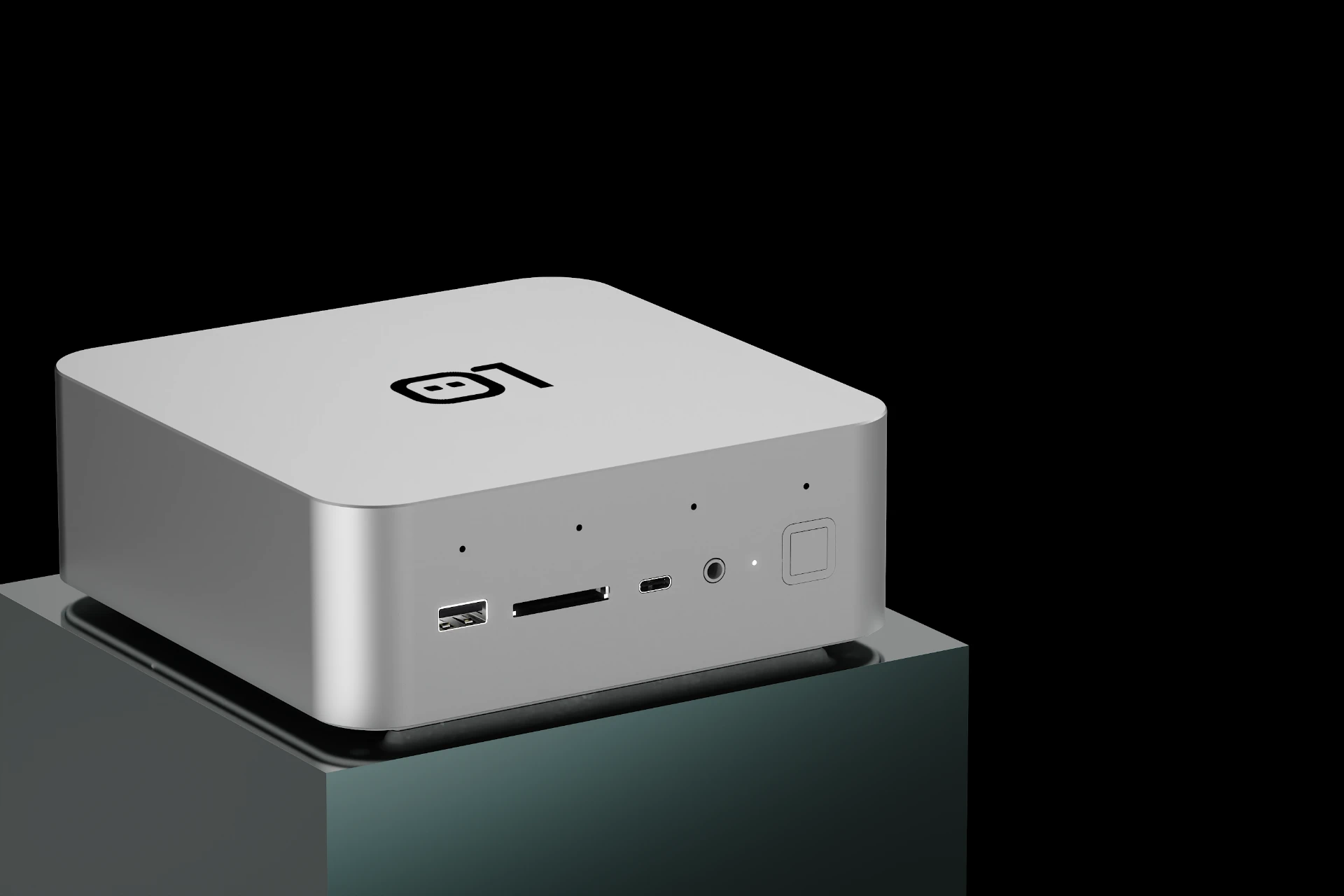
Front I/O
USB-A, SD card reader, USB-C, 3.5 mm audio and a fingerprint reader — the
things you reach for, on the side you face.
One continuous body
A single machined shell with a soft radius on every edge. No seams, no
vents on the faces you see.
Everything at the back
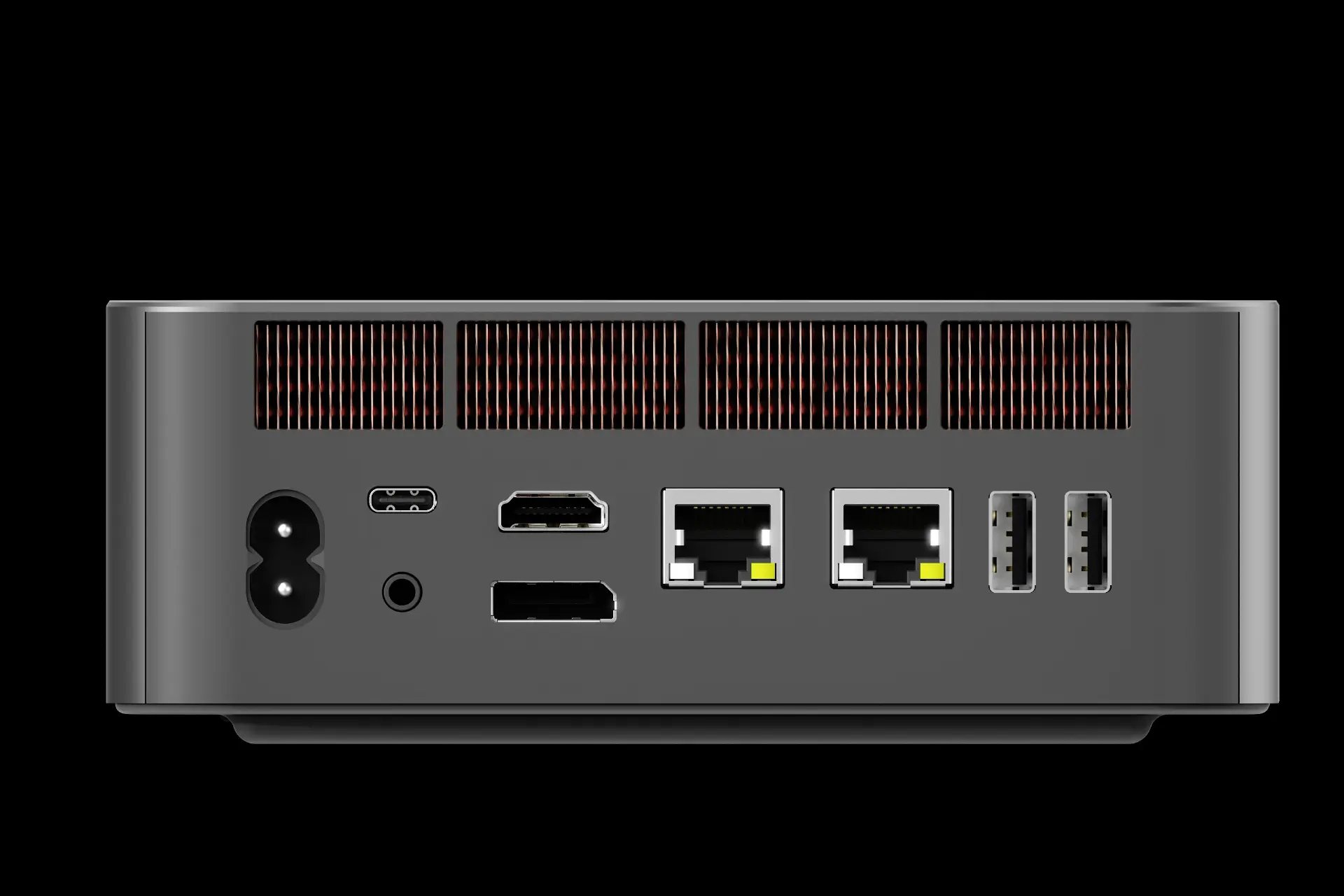
Dual 2.5 GbE, HDMI, DisplayPort, USB-C and the full-width thermal array
that lets it run silent under sustained inference.
158 mm square
Smaller than a sheet of A5 paper, holding two language models, eight agents
and your private memory.
The economics
Local LLMs + agents. Twenty-four seven.
2Local LLMs
+
8Agents
=
12Job roles
×
24/7Never offline
A SuperAgent coordinates eight
specialists, and between them they cover twelve job roles. They do not sleep, they do not
context-switch, and they cost electricity.
Modelled at a blended $85,000 per role. Illustrative, not a promise of
equivalence — an agent is not a person, and the roles above describe workloads, not job titles.
The operating system
OwnXOS. Built for models and agents, not retrofitted for them.
A lightweight open operating system on a NixOS base, with TPM2-protected
keys, Btrfs snapshots, atomic updates and one-command rollback. It boots to a desktop where
intelligence is already resident.
OwnXOS Control Centre — models, agents, wallet and tools, all local
Local modelsTwo compatible LLMs resident and ready, plus speech, vision and image runtimes.
SuperAgent + 8 specialistsAn agent runtime with identity, memory and coordination built in from boot.
AI Control CentreExecution route, region, cost per task, budgets and approvals in one panel.
Private vaultEncrypted local storage and vector memory that never syncs unasked.
OwnXCloud clientBurst to 34 providers across 482 regions, under rules you set.
Dev environmentRuntimes, editors and pipelines, reproducible and pinned by hash.
OwnApp StoreModels, agents, skills and MCPs — one click, local first.
Every agent inherits ten systems it
cannot opt out of: identity, permissions, memory, data access, wallet, budget, payment policy,
usage metering, audit history and compute routing. Nothing spends without a rule you wrote.
Every action leaves a receipt.
01
IdentityEvery agent action carries an identity you control.
02
PermissionsWhat each agent may read, run and reach — set by you.
03
MemoryPrivate vector storage and long-term context, on device.
04
Data accessFolder-level rules. Nothing wanders.
05
WalletERC-4337 smart account with TPM2-protected keys.
06
BudgetPer-agent spending limits the machine enforces.
Compute routingOn-device first. OwnXCloud second. API only if approved.
OwnApp Store
One place on the device to install intelligence.
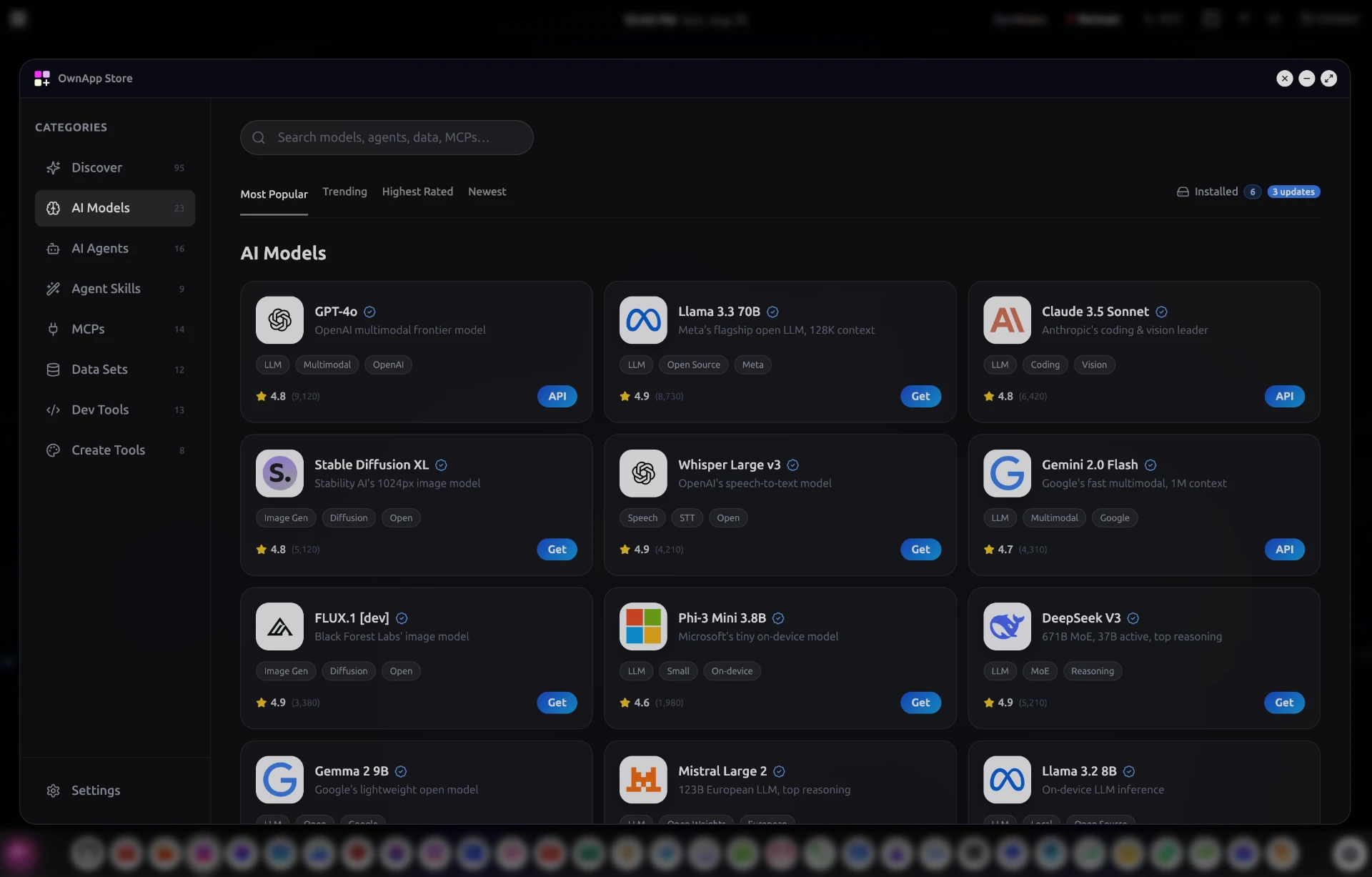
Models, agents, skills, MCPs, data sets and dev tools — searchable, rated
and versioned, the way an app store should be. Except what you install here is a mind, not an app.
Discover95
AI Models23
AI Agents16
Agent Skills9
MCPs14
Data Sets12
Dev Tools13
Create Tools8
Eight shelves, one hundred and ninety listings at launch, all installable
without leaving the machine.
The store tells you which models you can actually own.
Open weights carry a Get button — they download and run on your
hardware, offline, forever. Closed models can only ever be an API call to someone else's
building. Same shelf, and the difference is impossible to miss.
L
Llama 3.3 70BMeta · flagship open LLM, 128K context
Get
D
DeepSeek V3671B MoE, 37B active · top reasoning
Get
S
Stable Diffusion XLStability AI · 1024px image model
Get
W
Whisper Large v3OpenAI · speech-to-text
Get
F
FLUX.1 [dev]Black Forest Labs · image model
Get
P
Phi-3 Mini 3.8BMicrosoft · tiny on-device model
Get
G
GPT-4oOpenAI · multimodal frontier model
API
C
Claude 3.5 SonnetAnthropic · coding & vision leader
API
G
Gemini 2.0 FlashGoogle · fast multimodal, 1M context
Local when possible. The world when it's worth it.
Own 1 decides what should stay personal — weighing privacy sensitivity,
model size, local hardware, cloud price, latency, energy and budget before a task is allowed to
leave the device at all.
Bursts to 34 providers across 482 regions when a job needs more than a desk can
give. You choose the country.
$3.68 per 1,000 tasks
Only if approved
Hosted API
A frontier API is never reached silently. It requires your explicit approval,
every time.
$1.50 per 1,000 tasks
Costs modelled on one open model run in four places, where only the location
changes. A rented GPU for the same work runs $10.48 per 1,000 tasks.
Stablecoins & agents
An agent that can work but cannot pay is only half an
employee.
The moment an agent needs a model, an API or an hour of GPU, it hits a
checkout built for humans. Own 1 gives it a wallet instead — and a policy it cannot exceed.
Cards were built for peopleA card needs a human, a billing address and roughly a thirty-cent floor. An agent paying
$0.004 for one inference call needs none of those things.
x402 makes payment a protocolHTTP 402 Payment Required was reserved in 1997 and never used. It carries the price, the
agent pays, the request proceeds — no checkout, no account.
Stablecoins hold their valueDenominated in USDC, so the amount does not move while a job runs. Settlement in seconds,
in fractions of a cent, at any hour.
Signing policy · Marketing AgentActive
Account typeERC-4337 smart account
Key custodyTPM2, on device
Permitted actionTransfer USDC on Base
Total limit1,000 USDC
Per-task ceiling$3.00
Approval required above$2.00
Expires31 Dec 2026
240 USDC used760 remaining
1
RequestThe agent needs a paid model. The endpoint answers 402 with a price attached.
2
Policy checkOwnXOS tests it against the signing policy — action, amount, ceiling, expiry. Over the
threshold, it waits for you.
3
SignThe key never leaves the secure enclave. It signs one approved function, not a blank
cheque.
4
Settle & receiptPayment clears in seconds and the audit log records what ran, what it cost and which
agent asked.
A compromised agent cannot drain
an account it was never given. It can spend what you allowed, on what you approved, until the
date you set — and every attempt beyond that is refused and logged.
When one is not enough
Stack them.
Own 1 was designed to sit on top of itself. Four nodes occupy the
footprint of one, share a 10 Gbps fabric, and present as a single pool to OwnXOS — so a studio
grows by adding a box rather than renting a rack.
One node2 models · 8 agents · 10 seats
Four nodes8 models · 32 agents · 40 seats
Footprint158 mm square, unchanged
Beyond thatBurst to OwnXCloud
The part that compounds
The model gets cheaper. Your intelligence gets bigger.
The price of a model falls every quarter. Five years of your memory,
working style, documents, workflows and trusted relationships does not. Own 1 builds a Personal
Intelligence Profile that lives locally — the more it learns, the more useful it becomes, without
any of it accumulating in someone else's dataset.
That is the whole bet. Rent intelligence and you own nothing when the
subscription lapses. Own the machine and the commodity underneath you keeps getting cheaper while
what you have built keeps getting more valuable.
Preliminary and subject to change before production. Figures follow the
current engineering configuration; earlier published material quotes different core counts and
memory ceilings, and will be reconciled at launch.
Reserve
From three people up, it pays for itself inside the year.
Around $4,000 once, and roughly $8 a month in electricity after that. A
single light user should not buy this machine. A household, a studio or a small team should.
Ten seats works out at roughly $450 per person, once. Payback against
equivalent AI subscriptions lands around month eight, excluding electricity.
Questions
The things people actually ask.
What can it actually run at once?
Two compatible local models simultaneously, alongside vector storage, private memory, voice services and up to eight specialised agents coordinated by a SuperAgent. That is the difference between running a model and running a team.
How does it decide what leaves the machine?
It weighs privacy sensitivity, model size, local hardware, cloud price, latency, energy and budget before a task is allowed to leave at all. Local when possible, OwnXCloud when it is genuinely cheaper or faster, a hosted API only if you approve it.
What is the Personal Intelligence Profile?
The context, working style, tools, documents, workflows, agent history and trusted relationships the machine learns about you — held locally. It makes the device more useful over time without any of it accumulating in a central dataset.
Does it work with no internet connection?
Yes. The models are on the internal NVMe. The network is used only when you send a workload out, and the Control Centre shows you when that happens.
Can several people use one machine?
Up to five people reach it from their phones, and the machine supports up to ten seats. A household, a studio or a small team shares one device.
Is there a subscription?
No. The operating system, the local models and the applications carry no recurring fee. Beyond electricity there are no API bills and no credits to run out of. OwnXCloud is optional and billed only when a workload uses it.
What happens if an update breaks something?
OwnXOS is built on NixOS, so every update is a complete system generation with a Btrfs snapshot behind it. If a change causes a problem, you reboot into the previous generation.
How do I know the benchmarks are real?
1,224 runs across 44 models and seven modalities, over 55 days, on one fanless machine with integrated graphics — no datacenter, no outbound API calls. The 104 failures stay in the published dataset because they mark exactly where a small machine stops and OwnXCloud begins.
Own 1
Own your model. Own your data. Own your machine.
The future of intelligence must not belong to four companies. It starts
with one machine, on one desk, answering to one person.